
Public employees

People in the service of the Public Administrations are called public employees and are “those who perform paid functions in the Public Administrations in the service of general interests”.
Consolidated Text of the Law on the Basic Status of Public Employees (TREBEP)
Public employees are classified into career officials, interim officials, labor personnel and contingent personnel.
There is also the professional management staff, which is not a class of public employee.
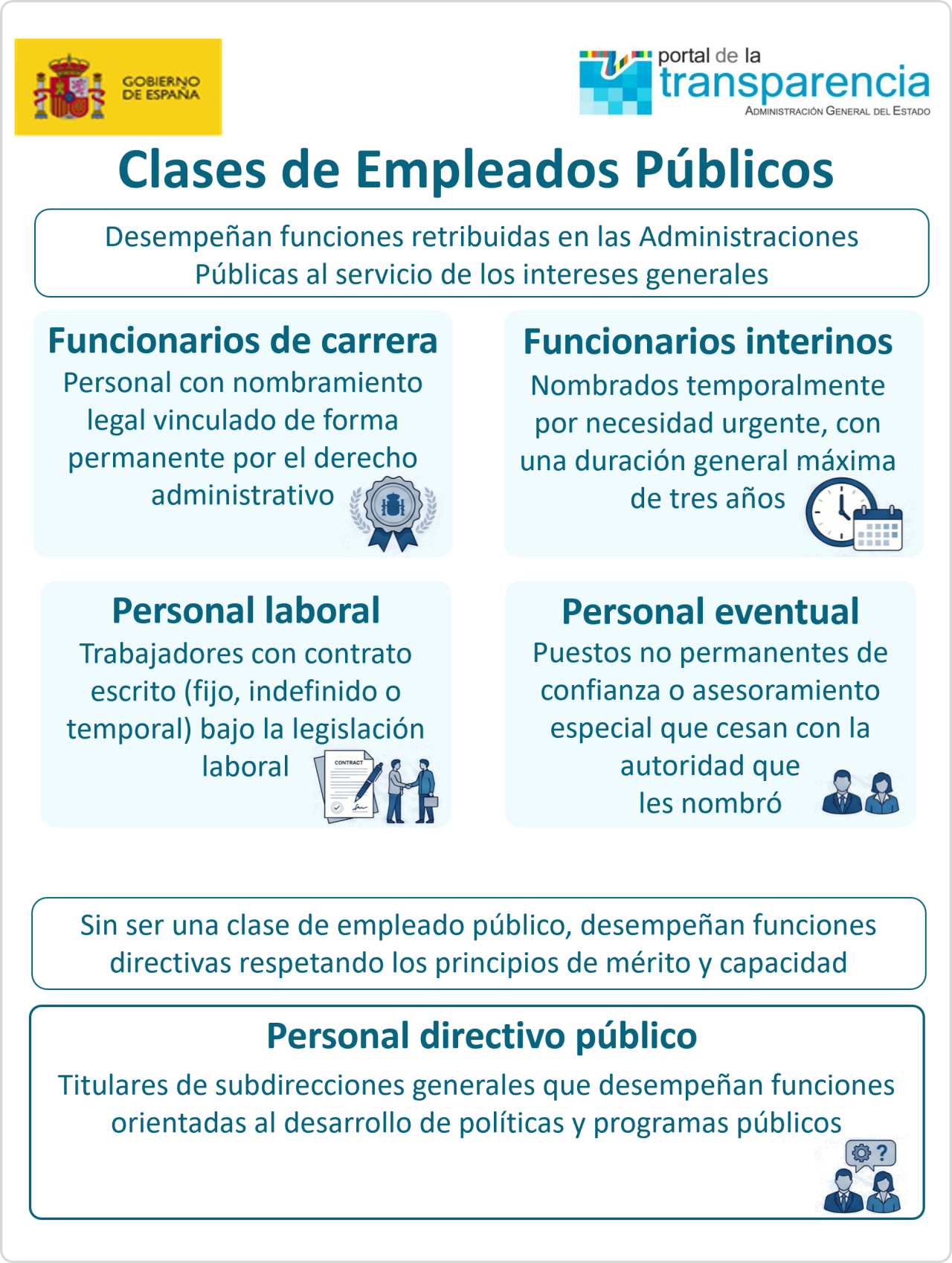
Career officers are persons who have been appointed according to the legally established procedure to work permanently in a Public Administration. Their employment relationship is regulated by rules of administrative law and they perform paid professional services.
They have the right to a professional career and to internal promotion.
Interim officers are persons who are appointed on a temporary basis to perform duties peculiar to career officers only when there is an urgent and justified need.
They can be named in these cases:
- When there are vacant positions that cannot be filled with career officials. In this case, the appointment can last up to three years.
- When it is necessary to temporarily replace an official who is absent, and only during the necessary time.
- To work in temporary programs, which can last up to three years, expandable up to a maximum of twelve months if permitted by the laws of Public Service.
- When there is an excess or accumulation of work, for a maximum of nine months within a period of eighteen months.
The workforce is the one who works for a Public Administration through a written contract, according to the forms of contracting provided in the labor legislation. He gets a salary for his work.
Depending on how long the contract lasts, these personnel may be fixed, for an indefinite or temporary period.
Contingent personnel are those appointed by a Public Administration on a non-permanent basis to perform tasks of trust or special advice. It charges a salary that is specifically provided for in the budgets.
Public Service laws will decide which governing bodies may have such personnel.
Each governing body will determine how many people it can name and how much they will charge.
Both the number of posts and their remuneration must be public.
The appointment and dismissal of these personnel are free.
In addition, the person automatically ceases if he or she leaves office the authority he or she advises or trusts.
Working as a temporary staff does not count as a merit to access the Public Service or to promote within it.
These staff are subject, where appropriate, to the same rules as career officers.
Professional public managers are those who perform managerial functions for the development of public policies and programs, with autonomy, according to the criteria and direct instructions of their superiors and with responsibility in their management and control of the fulfillment of the objectives proposed in the development of the action plans of the organization in which they carry out their functions.
It is made up of persons holding sub-directorates-general or similar positions.
The management staff is the one who carries out professional management tasks within the Public Administrations, according to what each Administration establishes in its own rules.
In order to elect these staff, the principles of merit and ability must be respected, and whether the person is suitable for the position must be assessed. The selection must be made through public procedures, where several people can participate under equal conditions.
The appointment and dismissal of professional public management positions in the State Administration shall in any case be carried out under the procedure of free appointment.
Managers must be evaluated, taking into account their effectiveness, their efficiency, their responsibility in management and the results obtained with respect to the objectives set for them.
The conditions of employment of managers are not the subject of collective bargaining.
If this personnel has the status of working personnel, the special regulations of senior management will be applied.
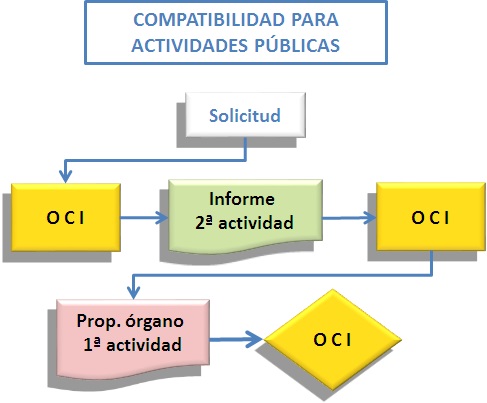
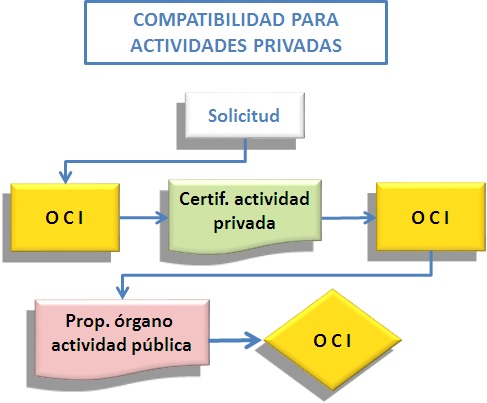
In this section you can see the procedure for granting a compatibility, depending on whether the current job is compatible with another public activity or with a private activity.
Access the specific information by clicking on the infographic of the corresponding procedure.
Public employees and employees shall exercise due diligence in the tasks assigned to them and shall ensure general interests subject to and in accordance with the Constitution and the rest of the legal system and shall act in accordance with the following principles:
- objectivity,
- integrity,
- neutrality,
- responsibility,
- impartiality,
- confidentiality,
- dedication to public service,
- transparency,
- exemplification,
- austerity,
- accessibility,
- effectiveness,
- honesty,
- promotion of the cultural and environmental environment and
- Respect for equality between women and men.
The rules and principles established in Legislative Decree 5/2015 will inform the interpretation and application of the disciplinary regime of public employees.
Royal Legislative Decree 5/2015, of 30 Octoberapproving the consolidated text of the Act on the Basic Status of Public Employees (arts. 52-54).