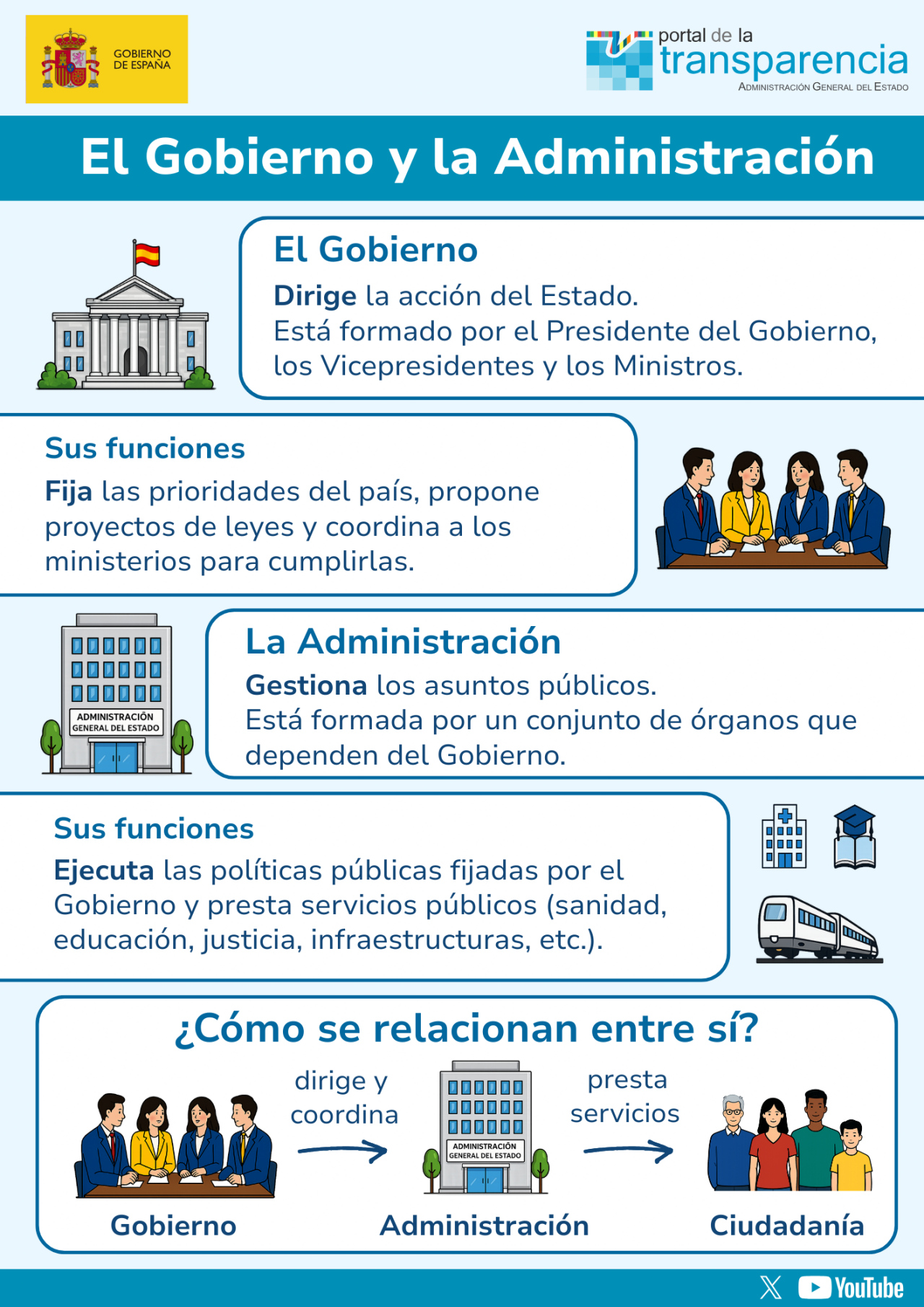
The Government is a political body. They highlight: Its members, functions and relations with the other powers and institutions of the state.
Its members are the President of the Government and the Ministers. The President directs it. They meet in the Council of Ministers and Commissions. Everyone assumes the decisions taken in a collegiate manner.
What do you do?” : It directs international, national policy and administration; proposes draft laws and budgets to the Cortes Generales; approves regulations. In short, it develops, promotes public policies and implements the laws approved by the Cortes Generales.
The relations of the executive power and the other institutions are key to understanding its legitimacy, how it develops its functions and how it is supervised. This ensures balances and prevents abuses.
The Head of State, the King, appoints the President of the Government after speaking with the parties represented in Congress, considering the members of Congress elected in the elections. The candidate for president gives him the capacity to form a government, which will achieve with the support of the Congress of Deputies to it. The President of the Government proposes the appointment of the Ministers to the King, who appoints them.
The Cortes Generales as representatives of citizens have a particularly relevant role in their relationship with the Government:
They give or withdraw their support to the government. In order to be able to carry out its functions properly, the Government needs the support of the General Courts, for example, to approve a law proposed by it. If this trust disappears, a new government is appointed with support in Congress or new elections are called. This relationship of trust is especially reflected in the investiture, the motion of censure and the question of trust.
The General Courts approve the General Budget of the State, that is, the expenses of the Government and the laws proposed by the Government.
The Courts supervise and control the actions of the Government, for example, through specific sessions devoted to the control of the Government, parliamentary questions and commissions of inquiry.
The Ombudsman and the Court of Auditors monitor the work of the Government and Administrations and report back to the General Courts.
The judiciary, the courts, control the legality of the government’s actions.
The Constitutional Court guarantees respect for the Constitution by the government.